GANXING Technical Guide
Rotary vs Dual Action Polisher: Motion, Cutting Power and Risk
Compare rotary, free-spinning DA, and forced-rotation polishers by motion path, correction speed, finish quality, and operator control.
Quick answer
A rotary polisher drives one direct rotation and corrects quickly, but concentrates heat and technique risk. A free-spinning DA combines rotation and orbit for a broader safety margin. Forced rotation sits between them, maintaining driven motion under load while still using an orbital path.
Three motion systems
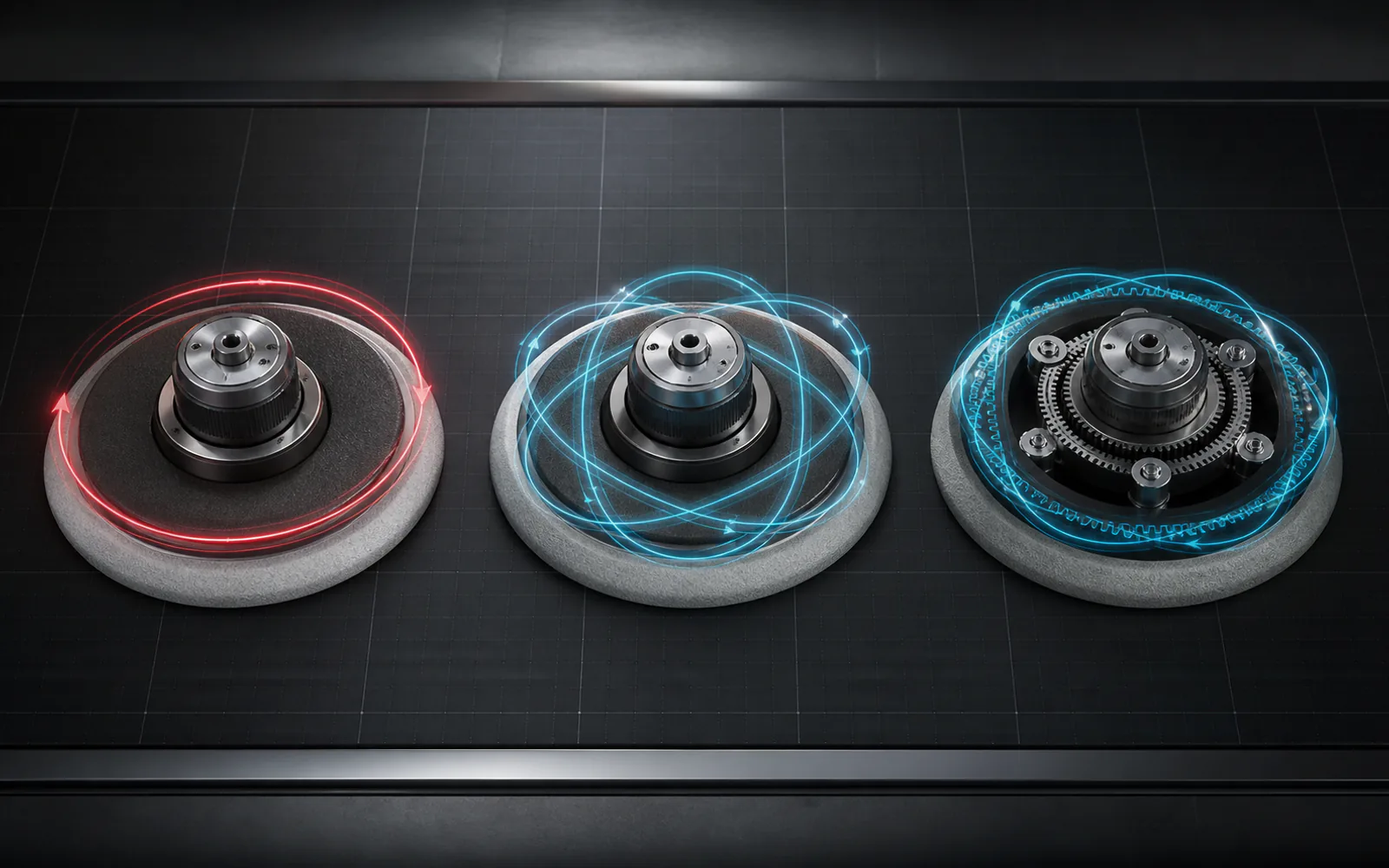
| System | Motion | Main strength | Main control point |
|---|---|---|---|
| Rotary | Direct rotation around one axis | Fast cut and precise local correction | Heat, pad angle, edge loading, holograms |
| Free-spinning DA | Orbit plus rotation generated by motion and friction | Balanced finish and lower concentration of heat | Rotation can stall on curves or under excess pressure |
| Forced rotation | Gear-driven rotation plus orbit | Consistent driven correction under load | More reaction torque and technique demand than free DA |
Choose by defect, geometry, and operator
- Choose free-spinning DA for general swirl removal, finishing, sensitive paint, and operators building consistency.
- Choose rotary when correction speed, edge control by an experienced operator, or heavy local defect removal is the priority.
- Choose forced rotation for demanding correction where a free-spinning pad repeatedly stalls but an orbital finish path is still preferred.
- Use mini polishers for pillars, bumpers, mirror housings, tight contours, and spot correction rather than forcing a large pad into a small area.
Orbit size changes coverage and access
A larger orbit covers and corrects broad, open panels efficiently. A smaller orbit is easier to place on narrow sections and complex contours. Orbit size is not a quality score; it is a geometry and process choice.
Pad diameter, pad thickness, backing plate, machine balance, paint behavior, and abrasive system all change the result. Compare the whole system rather than one specification.
Technique matters more than the label
- Keep the working face controlled and avoid loading a sharp edge with the pad perimeter.
- Use a test spot and inspect after short cycles instead of assuming one universal speed.
- Match the machine to the panel, not the panel to the machine.
No machine is burn-proof
Edges, raised body lines, repainted panels, contaminated pads, excessive cycles, and poor contact can damage a finish with any motion system.
Safety note: This guide provides a decision framework and does not replace an on-site assessment of the surface, coating thickness, material compatibility, or the machine manual. Test a small area first and use appropriate PPE.